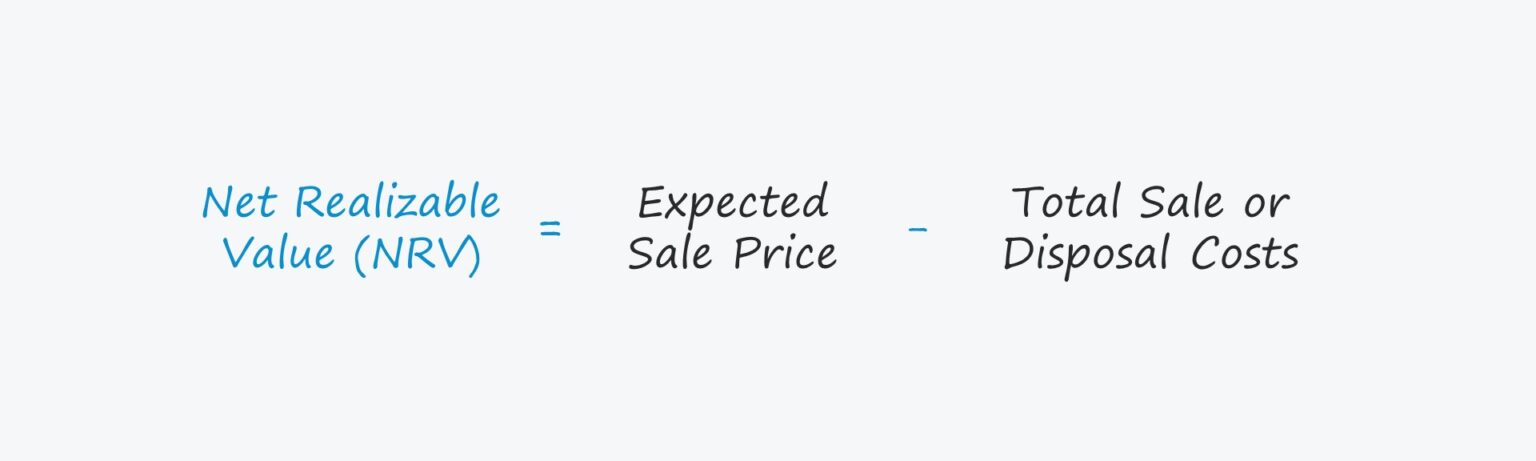
The Net Realizable Value (NRV) is the profit realized from selling an asset, net of any estimated sale or disposal costs.
In practice, the NRV method is most common in inventory accounting, as well as for calculating the value of accounts receivable (A/R).
How to Calculate Net Realizable Value (NRV)
The net realizable value (NRV) is an accounting method to appraise the value of an asset, namely inventory and accounts receivable (A/R).
In accordance with the principle of conservatism, the value of assets must be recorded on a historical basis per U.S. GAAP accounting standards to impede companies from inflating the carrying value of their assets.
For example, a publicly-traded company must recognize the value of its inventory on the balance sheet at either the historical cost or the market value, based on whichever option is lower.
In effect, companies are prevented from overstating the value of their inventory, which reduces the risk of misleading investors.
Therefore, the net realizable value (NRV) estimates the amount that a seller would expect to receive if the asset in question was sold, net of any selling or disposal costs.
The accounting standards established under U.S. GAAP require companies to strictly abide by the conservatism principle to appraise the value of assets.
The steps to calculate the net realizable value (NRV) are as follows:
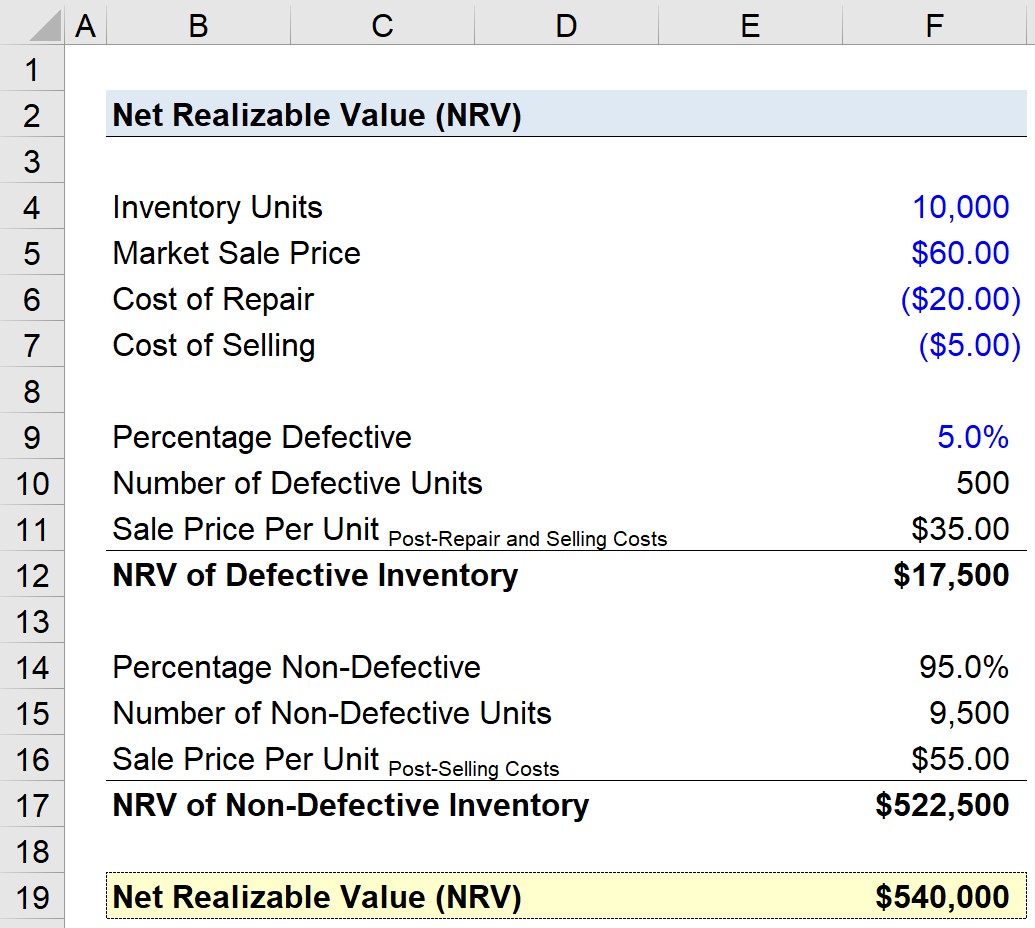
Suppose a manufacturing company has 10,000 units of inventory that it intends to sell.
The market value on a per-unit basis is $60.00, and the associated selling costs are $5.00 per unit, but 5.0% of the inventory is defective and requires repairs, which costs $20.00 per unit.
Inventory Units = 10,000 Units
Market Sale Price = $60.00
Cost of Selling = $5.00
Cost of Repair = $20.00
Since 5% of the inventory is defective, that means 500 units require repairs.
% Defective Inventory = 5.0%
Defective Units = 500 Units
The sale price per unit for the defective units – upon incurring the repair and selling costs – is $35.00 per unit.
Sale Price Per Unit (Defective) = $60.00 – $20.00 – $5.00 = $35.00
2. NRV Calculation Example
The NRV of the defective Inventory is the product of the number of defective units and the sale price per unit after the repair and selling costs.
Net Realizable Value (NRV)= 500 Units × $35.00 = $17,500
The percentage of non-defective inventory units is 95%, so there are 9,500 non-defective units.
% Non-Defective Inventory = 95.0%
Non-Defective Units = 9,500 Units
To calculate the sale price per unit for the non-defective units, only the selling costs need to be deducted, which comes out to $55.00.
Sale Price Per Unit (Non-Defective) = $55.00
We’ll multiply the number of non-defective units by the sale price per unit after selling costs, resulting in the NRV of non-defective inventory of $522,500
The net realizable value (NRV) of our hypothetical company’s inventory can be calculated by adding the defective NRV and the non-defective NRV, which is $540,000.
Net Realizable Value (NRV) = $17,500 + $522,500 = $540,000
Continue Reading Below
Step-by-Step Online Course
Everything You Need To Master Financial Modeling
Enroll in The Premium Package: Learn Financial Statement Modeling, DCF, M&A, LBO and Comps. The same training program used at top investment banks.
Unfortunately, there is a mistake in the task. If I understood the written part of the task correctly, then associated selling costs are $20 per unit but not 5$
Justin Kim
January 23, 2023 6:23 am
The cost of repair is $20.00 per unit, while the cost of selling is $5.00 per unit.
The sale price per unit – post-repair and selling costs – is thus $35.00 ($60.00 – $20.00 – $5.00).






Comments
Unfortunately, there is a mistake in the task. If I understood the written part of the task correctly, then associated selling costs are $20 per unit but not 5$
The cost of repair is $20.00 per unit, while the cost of selling is $5.00 per unit.
The sale price per unit – post-repair and selling costs – is thus $35.00 ($60.00 – $20.00 – $5.00).
Thanks!