Skip to main content

About Financial Edge
Financial Edge is Wall Street Prep’s London-based training partner and part of the Wall Street Prep group since 2025.
It runs instructor-led new-hire training for leading investment banks, private equity firms and asset managers.
This boot camp is taught by Financial Edge instructors, and you’ll receive a Financial Edge desk-ready certificate on completion.
Future-Proof Your Financial Modeling SkillsLearn to Direct Claude With Precision


-
You Control the Logic. Claude Does the Building.
You'll direct Claude to build an integrated three-statement model, DCF, trading and transaction comps and an LBO in Excel, with no manual formula entry. The instructor guides prompting, validation and real-time correction at every step.
-
Every Model Comes With an Audit Trail
Each session documents assumptions, prompts, outputs and corrections, so Claude-built models meet the same review standards as manually built ones.
-
Used by Top Financial Institutions
Taught live online by Financial Edge, which trains incoming analysts at top investment banks.
Earn the Desk-Ready Certificate
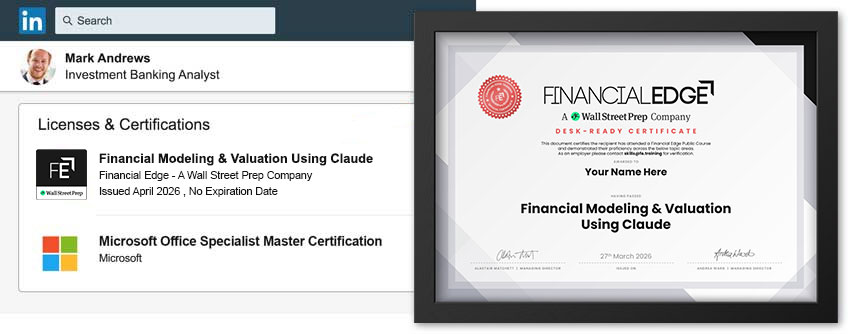
Complete the program to earn a desk-ready certificate from Financial Edge & Wall Street Prep. Show employers you have the latest accelerated modeling skills.
Agenda
This event is in Greenwich Mean Time (GMT).
Each day runs from 9a-5p.
Each day runs from 9a-5p.
Day 1
Day 1
Financial Modeling & Trading Comps
In the morning you'll direct Claude to build an integrated three-statement forecast from raw data, covering modeling standards, revenue and cost drivers, the cash sweep and circular reference handling. The afternoon covers audit trails for AI-assisted models, the EV-to-equity bridge and a full trading comps build with an implied valuation range.
Day 2
Day 2
DCF, Transaction Comps & LBO Valuation
You'll build a peer-based WACC grid and a DCF linked to the forecast model, then work through precedent transaction analysis. The afternoon covers LBO fundamentals, from sources and uses to a pro-forma balance sheet and debt service projections, and brings every method together in a football field and valuation deck.
Online
Online
Post-Course Online Access
Enrollment includes 3 months of Felix Pro: exercises, model files and additional content to consolidate what you covered, plus the Felix Connector for Claude.
Full Syllabus
Day 1: Financial Modeling & Trading Comps Valuation Using Claude
Morning: Financial Modeling & Forecasting (3 hours)
Modeling standards and best practices using Claude (60 mins)
- What Claude can and cannot do for financial modeling, appropriate use cases and how to set it up for finance work
- Enforcing modeling standards: consistent formatting, sign conventions, labeling, color-coding and cell styles, without touching Excel directly
- Generating best-practice model layouts: inputs separated from calculations, clear left-to-right flow, named ranges
- Identifying and fixing errors in an existing model: circular references, broken links, hardcoded overrides and inconsistent formulas
- Building integrity checks: conditional formatting, error flags and dashboard summaries
- Exercise: direct Claude to apply modeling standards to a messy template, then review and correct its output in real time
Detailed revenue and cost breakdown using Claude (30 mins)
- Building top-down and bottom-up revenue forecasts by product, geography, division or pricing tier
- Modeling revenue and margin drivers: price-volume analysis, growth rate assumptions and scenario analysis
- Detailed cost build-up: fixed vs. variable, headcount-driven costs, SG&A components and inflation-linked escalators
- Building capex and working capital schedules linked to revenue drivers
- Bridge analysis: reconciling top-down forecasts to bottom-up detail
- Exercise: direct Claude to expand a top-line forecast into a granular revenue and cost model
Building an integrated three-statement forecast using Claude (90 mins)
- Building an income statement forecast from historical financials: cleaning data, identifying key drivers and structuring the template, all via prompting
- Constructing the balance sheet: working capital schedules, PP&E roll-forwards, retained earnings and debt schedules
- Building the cash sweep and linking the balance sheet to the cash flow statement
- Connecting operating, investing and financing cash flows from balance sheet movements
- Handling the iterative circular reference (interest expense, debt balance and cash flow): switches and iteration settings
- Building base, best and worst case scenario toggles with CHOOSE, OFFSET and INDEX/MATCH, then validating outputs
- Preparing the model for handover: formatting, output presentation and pitch book readiness
- Exercise: direct Claude to build a fully integrated three-statement forecast from a raw data set, validating and correcting at each step
Afternoon: Model Audit, EV Bridge & Trading Comps (3 hours)
Audit trails for AI-assisted models (30 mins)
- Documenting key forecast assumptions: revenue growth, margin drivers, working capital, capex and financing inputs
- Creating a clear audit trail of how Claude built and linked the three statements
- Reviewing integrity checks: balance sheet balancing, cash flow linkage, circularity handling and scenario toggle outputs
- Documenting formulas, assumptions, AI prompts, corrections and reviewer sign-offs for handover
- Exercise: direct Claude to generate a complete audit trail for the three-statement forecast, then review and correct it before handover
Enterprise value and equity value bridge using Claude (60 mins)
- Calculating equity value: market cap, diluted shares and the treasury stock method for options
- Building the EV bridge: net debt, non-controlling interests, preferred stock and unfunded pensions
- Identifying and classifying non-core and debt-equivalent items from financial statements
- Exercise: direct Claude to build the EV-to-equity bridge for a case company
Trading comparable company valuation using Claude (90 mins)
- Screening comparable companies by sector, size, geography, business model and operating characteristics
- Gathering and structuring data: market cap, EV, revenue, EBITDA, EBIT and net income
- Calculating LTM metrics and calendarizing reported figures
- Applying pro-forma adjustments: acquisitions, divestitures, and IFRS vs. US GAAP lease treatment
- Normalizing multiples (EV/Revenue, EV/EBITDA, EV/EBIT, P/E) and running statistical analysis: mean, median, IQR and outliers
- Applying multiples to the target to derive an implied valuation range
- Exercise: direct Claude to build a full trading comps table from scratch
Day 2: DCF, Transaction Comps & LBO Valuation Using Claude
Morning: WACC, DCF & Transaction Comps (3 hours)
WACC analysis using Claude (45 mins)
- Sourcing and calculating CAPM inputs: risk-free rates, equity risk premiums, and levered and unlevered betas
- Building a WACC grid from the peer group: individual company WACCs, interpreting dispersion and selecting the target’s cost of capital
- Estimating the cost of debt: credit spreads, borrowing rates and synthetic ratings
- Demonstrating the impact of capital structure on WACC
- Exercise: direct Claude to prepare a WACC grid for a set of comparable companies
Discounted cash flow model using Claude (75 mins)
- Calculating FCFF from the forecast model, linking valuation directly to the model already built
- Benchmarking operational ratios against peers
- Building terminal value with the exit multiple and perpetuity growth methods, with cross-checks
- Applying the mid-year convention and discounting to a deal date
- Converting EV to implied share price: options, RSUs, convertibles and non-controlling interests
- Two-way sensitivity tables: WACC vs. terminal growth, WACC vs. exit multiple
- Exercise: direct Claude to build a complete DCF linked to the forecast model
Transaction comps using Claude (60 mins)
- How transaction comps differ from trading comps, what they add and when they matter most
- Key mechanics: transaction multiples, control premiums, premium paid analysis and synergy comparables grids
- A worked precedent transaction example: screening, extracting and normalizing multiples
- Adding a transaction comps range alongside DCF and trading comps outputs
- Compiling low-to-high valuation ranges across all three methods
- Producing the football field chart: horizontal bars, annotations and implied share price ranges
- Explaining the key drivers of divergence across methods
- Generating the full audit trail: screening criteria, data sources, multiple selections and corrections
- Exercise: direct Claude through a precedent transaction example, from deal screening to normalized multiples, and set a defensible valuation range
Afternoon: LBO Modeling & Valuation Summary (3 hours)
LBO fundamentals and valuation using Claude (90 mins)
- LBO economics: entry assumptions, purchase price, control premium and equity contribution
- Building sources and uses: acquisition debt, equity check, arrangement fees, commitment fees and OID
- Constructing the pro-forma balance sheet: fair value adjustments, goodwill and the opening balance sheet of the acquired entity
- Projecting revenue, EBITDA and free cash flow available for debt service
- Presenting Claude-built LBO analysis to investment committees and credit teams
- Exercise: direct Claude to build an LBO model and set a defensible valuation range from target returns and exit assumptions
Valuation football field using Claude (30 mins)
- Combining DCF, trading comps, transaction comps and LBO outputs into a football field for the pitch book
- Using Claude to build a valuation deck from templates: key valuation pages, football field exhibits and supporting commentary
- Exercise: direct Claude to synthesize all valuation outputs into a football field and draft the supporting pitch book pages
Project self-study, preparation and team presentations (60 mins)
Prepare and present the completed analysis through self-study, team collaboration and final presentations.
3 Months Felix Pro Access
Felix is our industry-leading online learning platform. It delivers everything finance professionals and teams need to learn, practice and analyze. Build skills with instructor-led training, then apply them to real company filings, data and models.
Felix at a glance
- 4,700+ searchable training videos and expert interviews
- 560+ playlists, with quizzes and Excel tryouts on more than half
- 12 role-based pathways
- 50+ certified courses
- 160+ live webinars every year
- Filings and company data for 7,000 global companies
- 30,000+ analysts using Felix
- Expert answers within 48 hours
- Felix mobile app for learning and company data on iOS and Android
Learn at your own pace
Find the answer fast
Search by method, concept or question and get a short, instructor-led how-to video. No more digging through outdated or inaccurate answers online.
Follow a path built for your role
Each pathway runs from fundamentals to advanced content, whether you are heading into investment banking, equity research, sales and trading, private equity or credit analysis.
Prove it has stuck
Quizzes and Excel tryouts sit alongside the videos so you test yourself as you go. Earn certificates, from skills certificates to micro-degrees, with lifetime access to each course.
Learn live, ask anyone
Join Friday webinars with live Q&A, run at times that suit every time zone and saved to watch later. Between sessions, put technical questions to instructors who have worked at J.P. Morgan, Goldman Sachs, Barclays and more.
Practice on the real thing
See where every number comes from
Click any metric in a company’s equity to enterprise value bridge to jump to the exact line in the filing. You learn where to find the data, not just what it is.
Keep an audit trail
Annotate filings, rename and share them with colleagues, and review everything in one dashboard. Copy a number and its source link into Excel with CTRL + V.
Benchmark against the market
Download regional and industry data, refreshed monthly, covering multiples, cost of capital, growth, profitability, returns and capital structure.
Start from a working model
Open sector models for banking, insurance, oil and gas, pharma, REITs and telecoms, or transaction models for LBOs, mergers, IPOs and divestitures. Supporting playlists show how each one works, which helps new hires get up to speed in a specific industry group.
Wall Street Prep training is used at ...


Who is this Boot Camp For?

- Analysts and associates at investment banks, M&A advisory firms and corporates who want to integrate Claude into daily modeling and valuation work
- Finance professionals with existing modeling skills who want a structured, auditable AI workflow
- New entrants and career changers who want a credentialed, practical program in the core investment banking skill set
Boot Camp Details
Overview
This is a live, two-day online program built on one principle: you control the logic, Claude does the building. Day 1 covers financial modeling, forecasting and trading comps. Day 2 covers WACC, DCF, transaction comps and LBO valuation. Every model is built live in Excel, so you leave with working model files you can adapt for your own work.
AI Tools & Workflow
Claude interfaces directly with Excel to build and update every model, with no manual formula entry. You’ll learn to prompt with precision, validate outputs rigorously and correct errors in real time. Every session includes a structured audit trail, so Claude-assisted work meets the same documentation and review standards as a manually built model.
Delivered by Financial Edge
This boot camp is delivered by Financial Edge, a London-based finance training firm and part of the Wall Street Prep group since 2025. Financial Edge runs instructor-led new-hire training for leading investment banks, private equity firms and asset managers, supported by its Felix online learning platform.
Felix Platform Access
Enrollment includes 3 months of Felix Pro, with exercises, model files and additional content to consolidate what you covered. It also enables the Felix Connector for Claude, used in class to bring data into your models.
Live Online Format
Sessions run live on Zoom, and the prompting and correction exercises depend on real-time participation. Cameras are encouraged but optional. A recording is available to enrolled participants after the session.
What’s Included?
Two days of live, instructor-led training via Zoom, fully functional model files, a session recording, 3 months of Felix Pro access, and a desk-ready certificate.
Prerequisites
A Claude account (Pro plan recommended), the Claude and Felix add-ins, and Microsoft Excel. Familiarity with Claude’s core features is recommended. Some familiarity with financial statements helps, and the DCF, transaction comps and LBO sessions suit those with a working knowledge of valuation.
Trainee Reviews
"The course includes really good information that will be valuable going forward. It was very good, the same level or above compared to other courses taken."
— Daniel P.
"The course is very useful and fun. It is a great way to learn how to model and to be able to understand by asking questions. Loved it!"
— Alice S.
"The instructors were everything you could ask for – extremely knowledgeable, responsive, helpful, and did a great job of breaking down difficult concepts. They were also highly knowledgeable and always there to help. This course was far more effective, relevant, and in-depth than others I have taken."
— Andrew A.
"It’s really good to have someone who has so many years of actual practical experience to go over the materials and share real life insights as to why we do these instead of just going through the content or the ‘how’."
— Livia L.
"Solid overview of most important concepts and practices."
— Maksim S.
"The course material is very applicable for equity research, particularly the non-gaap financials and all of the excel shortcuts and tips that were taught. I’m taking away a lot of useful excel functions and shortcuts that I’ll be using everyday now."
— Greg P
Why Attend a Boot Camp?

Comprehensive Training
Our live courses pulls no punches. Each boot camp is the same intensive training used to prepare incoming analysts at top financial institutions.

Learn by Doing
Attendees "learn by doing" by working through practical exercises and building financial models from scratch using real case studies.

Networking Opportunity
Boot camps provide an opportunity to network with MBAs and professionals from industries including investment banking, corp dev and FP&A.

Experienced Instructors
Our instructor-practitioners are experienced bankers who give real-world context by connecting training to their own experience on the desk.

Excel Mastery
Our training reinforces speed, efficiency and consistency in Excel that investment banking analysts are expected to have on Day 1.

Continuing Ed & Webinars
Enrollment to most boot camps includes access to our continuing education online training platform and webinar series.
Further Reading


Cancellation & Transfer Policy
Participants who are unable to attend their scheduled boot camp may request to transfer their registration to a future Wall Street Prep Public Boot Camp. Requests must be submitted at least 1 week prior to the original seminar start date. The following conditions apply:
- Only one transfer is permitted per registration.
- The transfer must be used within one year of the original seminar date.
- Transfers are final and non-refundable.
- If the new boot camp has a higher registration fee, the participant will be responsible for paying the difference. No refunds or credits will be issued for transfers to a lower-priced boot camp.
- Participants who cancel within 1 week of the seminar start date, or who do not attend without prior notice, are not eligible for a transfer or credit.
Wall Street Prep reserves the right to cancel a seminar due to low enrollment or unforeseen circumstances. If Wall Street Prep cancels a seminar, participants may choose either a full refund or a transfer to a future boot camp.
The Wall Street Prep Quicklesson Series
7 Free Financial Modeling Lessons
Get instant access to video lessons taught by experienced investment bankers. Learn financial statement modeling, DCF, M&A, LBO, Comps and Excel shortcuts.